
 By
By 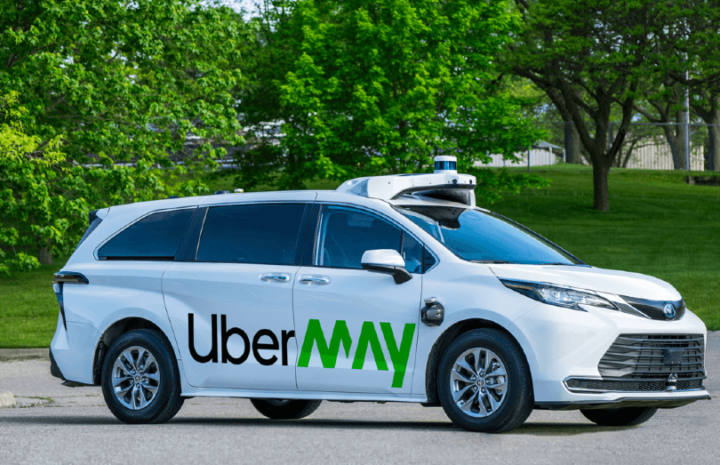
Industry leaders May Mobility and Uber partner to deploy thousands of autonomous vehicles over the next few years. Where are they deploying?
May Mobility has expanded its autonomous vehicle services, launching a fully driverless, small-scale deployment in Ann Arbor, Michigan. The service operates across a two-square-mile area of the city and is open to invited guests only. This deployment exposes their driverless technology to variable weather, higher speeds, and increased traffic conditions. Before going to Ann Arbor, the companies will launch AVs in Arlington, Texas, before the end of 2025.
A new market could prove fruitful
Autonomous vehicles could add as much as $1 trillion to the automotive market in the United States alone. This makes launching these vehicles economically important, but in these early days, the aggressive goals might prove to be challenging. That’s the case with any new technology or industry; breaking through can be the most difficult part of the process. That said, both companies involved are industry leaders with Uber offering ride hailing services used around the world and May Mobility being a leading company in the AV world.
Not the first launch of self-driving vehicles
Other companies, such as Waymo and Cruise, have launched autonomous vehicles in large cities to prove their viability. These vehicles were met with mixed reviews and results. Some passengers thought they were great and enjoyed riding without the driver taking over the controls, while others found the situation to be frightening and alarming. Regardless, the movement toward self-driving taxi services in various markets continues to be researched and moved forward. It’s almost inevitable that autonomous vehicles will be the future of taxi and ride-hailing services, much to the chagrin of drivers who rely on these services for their income.
What does the partnership bring together?
This partnership between Uber and May Mobility capitalizes on some of the best qualities of each company. Uber will offer the option of a May Mobility AV on the platform for qualifying trips while May Mobility offers a fleet of American-made hybrid-electric Toyota Sienna minivans equipped with the proprietary software that can drive the vehicles without human driver intervention.
While this is the goal of the partnership, the first deployment of vehicles will include onboard safety operators to take over driving duties if the software fails. Eventually, these vehicles will transition to driverless rides, which pushes the technology forward. If the initial launches in Arlington and Ann Arbor go well, these vehicles will appear in other U.S. markets in 2026. This is an aggressive plan but it could be the future of ride-hailing.
How does the software react on the road?
The platform used, which is called MPDM, applies real-time, human-like reasoning to handle unexpected situations with AI-powered speed and precision. This allows the vehicle to navigate real-world situations without relying on predefined scenarios, which have been challenging for other companies in the past. The system adapts to new scenarios and environments, which will certainly be tested during winter months in Ann Arbor, Michigan. The system can handle “edge cases,” which is an approach that has proven to work in the United States and Japan. Edge cases are those that require some form of human reasoning to find the best choice in a situation where multiple decisions could be possible.
The CEOs are excited
As you would expect, when two companies partner together to bring new technology to the masses, the leaders of these companies are very excited by the venture.
“We are thrilled to be partnering with May Mobility to continue to scale the availability of autonomous vehicles across the United States. At Uber, we’re building the future of transportation, working with the world’s leading autonomous vehicle developers like May Mobility to help commercialize and deploy this technology quickly at scale around the world.”
– Dara Khosrowshahi, CEO of Uber“Launching on the Uber platform is a big signal to the market that May Mobility is ready to quickly expand to major markets as the pre-eminent autonomy-as-a-service provider. Uber and May Mobility will make it possible for more people across the U.S. to enjoy the transformative benefits of autonomous vehicles.”
– Edwin Olson, CEO and co-founder of May Mobility
Will it work?
The partnership between Uber and May Mobility could work to bring AVs to the market, but will drivers choose a self-driven ride or stick with a more traditional method? How will the public feel about drivers being put out of work as AVs take over? Is the technology advanced enough to handle unforeseen circumstances? The answers lie in the future of this partnership.
This post may contain affiliate links. Meaning a commission is given should you decide to make a purchase through these links, at no cost to you. All products shown are researched and tested to give an accurate review for you.