
 By
By 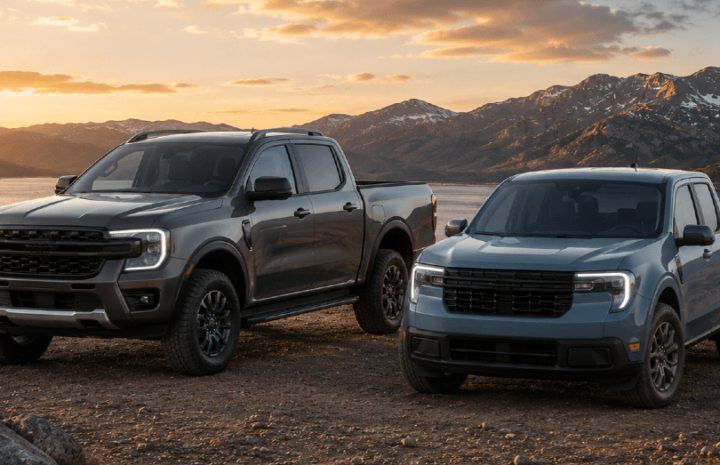
Two trucks, one badge, very different missions. The compact Ford Maverick and the midsize Ranger both wear the Blue Oval, but they’re built for shoppers with different priorities, budgets, and weekend plans.
- The Maverick starts thousands less and offers a hybrid powertrain rated up to 42 mpg city.
- The Ranger tows nearly twice as much and offers a 405-hp Raptor variant.
- Both come standard as Crew Cab/SuperCrew trucks with shared SYNC tech and B&O audio options.
Price and Trim Lineup
Budget is usually the first deciding factor, and the Maverick wins that round easily. The 2025 Maverick XL starts at $26,395, while the 2025 Ranger XL starts at $32,980. That’s a gap of more than $6,500 before you start adding options.
The 2025 Maverick got a fresh design for this model year and comes in five trim levels: XL, XLT, Lobo, Lariat, and Tremor. The Ranger keeps things simpler with four grades: XL, XLT, Lariat, and the high-powered Ranger Raptor.
Powertrains and Performance
The two trucks take very different approaches under the hood. Maverick buyers can pick between a 191-horsepower 2.5-liter hybrid four-cylinder paired with a CVT or a 250-horsepower 2.0-liter EcoBoost four-cylinder paired with an eight-speed automatic.
The Ranger gives you more muscle and more choices. It steps things up with three engines, including the standard 2.3L EcoBoost, an available 2.7L EcoBoost V6, and the Raptor-exclusive twin-turbo 3.0L EcoBoost that puts down 405 horsepower. The Ranger also runs a 10-speed automatic, helpful for fuel efficiency and for staying in the power band while towing.
If saving fuel matters more than chasing horsepower, the Maverick hybrid is hard to beat. The standard hybrid powertrain earns an EPA-estimated 42/35/38 mpg city/highway/combined.
Towing, Payload, and Bed Space
This is where the Ranger really stretches its legs. Properly equipped, the Maverick tows up to 4,000 pounds, while the Ranger maxes out at 7,500 pounds. If you regularly pull a boat, a car trailer, or a larger camper, the Ranger is the obvious pick.
Bed dimensions tell a similar story. The Ford Maverick has a 4.5-foot bed, while the Ranger offers a 5.0-foot bed that’s better suited for larger loads. The Maverick’s bed holds 33.3 cubic feet of cargo, while the Ranger’s bed swallows 43.5 cubic feet, a full 10.2 cubic feet more for gear, tools, or weekend toys.
That said, the Maverick punches above its weight with clever packaging. Its FLEXBED has molded-in slots for dividers, racks, and DIY storage solutions. You also get up to ten tie-downs, 12-volt pre-wiring, an available in-bed storage cubby, and a mid-position tailgate that makes hauling long or bulky items easier.
Size, Tech, and Daily Driving
The Maverick rides on a unibody platform, so it drives more like a crossover than a traditional pickup. The 2025 Ranger went through a redesign in the previous model year and uses a tougher body-on-frame setup built to handle rougher terrain and heavier loads.
Dimensionally, the Maverick measures 199.8 inches long compared with the Ranger’s 210.6 inches. The Maverick also stands 68.5 inches tall versus the Ranger’s 74.4 inches. Translation: the Maverick slips into compact parking spots that the Ranger has to think twice about.
Inside, the Maverick actually wins the screen war. Both trucks share Ford’s latest tech, but the Maverick gets SYNC 4 with a 13.2-inch touchscreen, while the Ranger uses SYNC 4A with a 12-inch touchscreen. The Ranger counters with more upscale touches, including an available ten-way power driver’s seat (the Maverick tops out at eight-way) and available leather upholstery.
Picking the Truck That Fits Your Driveway
Both trucks are genuinely good at what they do, just not at the same things. The Maverick suits drivers who want a smaller, fuel-friendly pickup for daily use, while the Ranger is built for buyers who need more power, more cargo room, and a higher tow rating. Commuters, first-time truck buyers, and anyone with a tight garage will love the Maverick. Tradespeople, off-road fans, and trailer haulers will get more out of the Ranger and its body-on-frame toughness. Either way, you’re getting a Ford pickup that’s earned its place on the road.
This post may contain affiliate links. Meaning a commission is given should you decide to make a purchase through these links, at no cost to you. All products shown are researched and tested to give an accurate review for you.